Singing was just about my favorite thing to do all throughout my childhood and teenage years. Church youth choir, chorus at school, an all-county choral society for sixth through twelfth grade that required an audition—I made it in as a rising seventh grader after a devastating rejection on my first try. The car, the shower, my bedroom floor. I did the dishes most nights in high school, discovering I didn’t mind them so much if I could sing Taylor Swift at the top of my lungs while I worked (and my sisters could bear my singing if they didn’t have to scrub roasting pans and wipe down countertops).
My best choral memories all center around holiday performances. Each fall, our high school chorus vigorously prepared to perform at the Candlelight Processional in EPCOT. This involved performing in a mass choir, comprised of our group and several other school choruses, accompanied by an orchestra, all while a minor celebrity read the Christmas story from Luke. Aside from the obvious delight of a trip to Disney World with my closest friends, the songs themselves were breathtaking. Mostly classic hymns, but all elaborately arranged into something new. We sang in French, Spanish, Latin. The rendition of Oh, Holy Night begins with a thunderous FALL!!! FALL ON YOUR KNEES!! We’d throw in contemporary songs for our more low-key school program prior before heading to Orlando. My friends and I giggled over the lyrics to I’ve Got My Love To Keep Me Warm (“the snow is snowing? Seriously?”) and the Wassail Song (several of us didn’t know what wassail was at the time, and the name sure is silly).
In sixth grade, though, I received the greatest honor an eleven-year-old chorus girl who still harbored dreams of becoming a famous singer someday could hope for: an invitation to perform an entire song as a solo at my middle school’s holiday concert. The song was White Christmas.
The performance itself is a blur in my memory, but what I could never forget was how much my parents loved it. My dad, in particular, talked about it for weeks, and weeks turned into years. He asked me to sing it every single Christmas after that. “Car, how about a little White Christmas? Come onn.” Even over a decade later, when all pop star aspirations were long extinguished, my dad loved telling the story of another father fist-bumping him after the performance at school, saying “That your daughter? You’ve really got something there.”
We learned about the mass in his abdomen the Monday after Thanksgiving last year. My mom called and told me, her voice gentle and steady, the same night I decorated my tree.
I made plans to go home as soon as I could, but those first two weeks of December unwrapped excruciatingly slowly. Each day seemed to bring a new horror, made all the more surreal by the surrounding festivity of the season. We learned that the mass was probably, and then definitely, cancer. It had started near the appendix, but it had spread to the liver. I bought a tartan dress and a red bow for my hair for the office holiday party. More tests were done. I spent an hour on the phone going over the diagnosis with one of my aunts, all the while pacing around a craft store as my husband and sister-in-law picked out Christmas lights.
One night, still early on, Dad had to stay overnight in the hospital because he was running a fever. The next morning, I went to the doctor for an ill-timed annual physical and had an attack of anxiety so strong that I gave myself a fever. I called Daddy at the hospital that same night on my drive home from a holiday benefit for the Ronald McDonald house.
Still, the music was everywhere, by choice as much as by circumstance. I played it in the car and in the house, even sometimes on headphones at my desk, trying desperately to focus on work. In the meadow we can build a snowman and pretend that he is Parson Brown. In my heart is a Christmas tree farm where the people would come and dance under sparkling lights. Bring a torch, Jeanette, Isabella, bring a torch to the cradle, run. In a year we all will be together, if the fates allow.
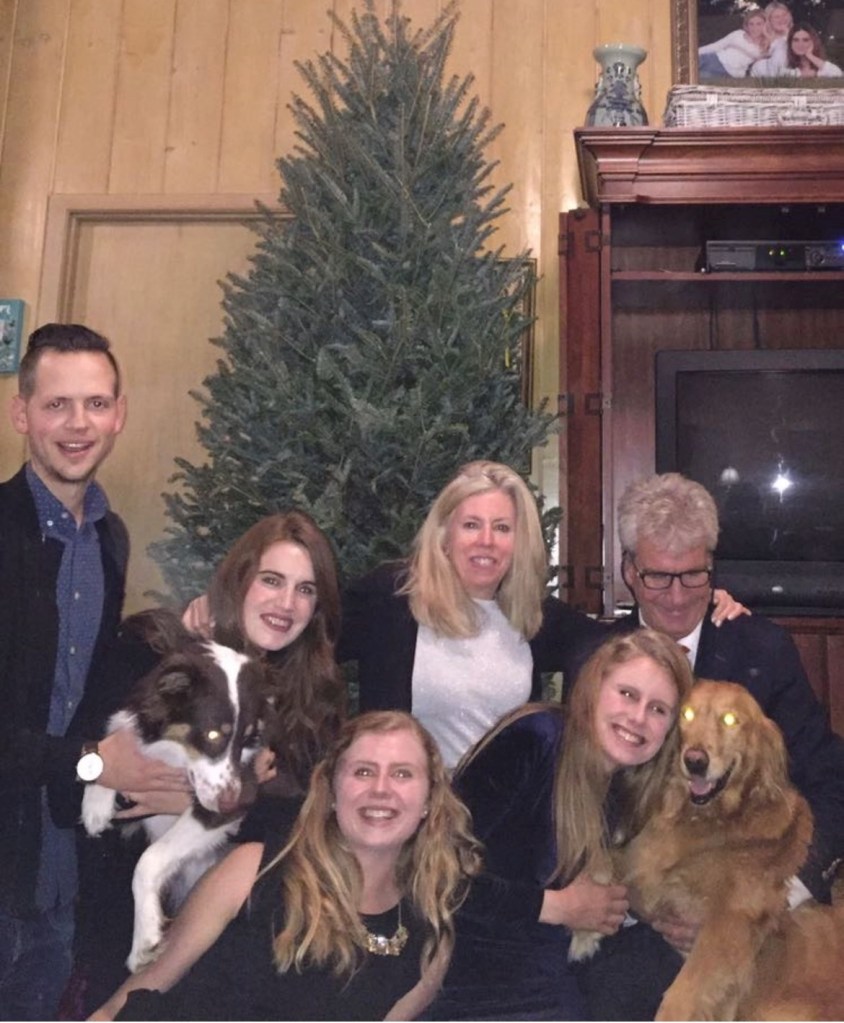
We all finally got home, and we made it through Christmas. Jamie brought home a puppy, Josie, who we dressed up in a red sweater with a cheetah collar and diamond buttons. I took Grace to her wedding dress fitting. There were walks on the beach and dinners around the table. Dad always took us girls on a last-minute shopping trip, usually on Christmas Eve, and even though his energy was low and everyone’s anxiety about covid and flu was high, we made the trek to the Coastal Grand Mall. Mom snuck out of bed in the early hours of Christmas morning to set out presents from Santa.
We’d been instructed to stay away from crowds, so our family priest, Father Pat, said a beautiful mass in our living room. After we’d finished, someone suggested a few songs. We started with the Prayer of St. Francis, and then, of course, White Christmas.
It’s only now that I try to discern what my dad loved so much about the song. It couldn’t be because he missed the brutal winters of Philadelphia. It would be easy – and true – to say that he loved to hear me sing because he loved me. But he certainly didn’t latch onto everything I performed in the same way he did this specific song.
My father loved things that were bittersweet, melancholy. He took my sisters and me to see the film adaptation of Because of Winn Dixie when we were kids, and for years after that, he referenced the movie whenever he ate hard candy: tastes melancholy. A passage from the book elaborating on this concept reads, “life was like a littmus lonzenge, how the sweet and the sad were all mixed up together and how hard it was to separate them out.”
One of the thoughts that has brought me the most solace since my dad’s death is remembering that he endured crushing loss himself, and yet had one of the greatest capacities for contentment, joy, and humor of anyone I’ve ever met.
When I look up the origins of White Christmas, I learn Irving Berlin lost a child on Christmas Day prior to writing the song. It was first performed by Bing Crosby on December 25, 1941, weeks after the attack on Pearl Harbor.
Ah, I recognize. It was the melancholy.
I’m not as comfortable with the concept as my Dad was yet. I remember raging a few months ago about how frustrated I was that it felt like nothing in my life could ever be purely happy again. Everything, I thought, everything good that could ever happen to me from now on, every win at work, every major milestone, every exciting trip, every particularly beautiful day, will still be sad, because I won’t be able to tell you about it.
Still not not true. But I’ve been trying not to resent that twinge, tug, catch in the back of the throat, so much lately. The concept of embracing melancholy is pretty. In practice, I heard White Christmas for the first time on the way home from dinner with my husband last week and I was doubled over in sobs that shook my whole body halfway through the first verse.
My personal favorite Christmas song is Oh, Holy Night. I’ve long loved the lyric, “a thrill of hope, the weary world rejoices.” To me, that’s Christmas summed up in eight words. The miracle of God made flesh in the humblest of settings. The sparkle of holiday lights and the hum of music amidst barren trees, frigid air, darkness descending earlier and earlier, an undeniably weary world. Joy and grief all tangled up as one.


Leave a Reply